
The infinite growth glitch
This is part of a series of articles in which I want to talk about how I ended up quitting my job. In part 1, I talk about the pandemic’s effects in focusing some the world’s problems in my mind. In part 2, I talk about my perspective on the different crises that are confronting us.
Two words that you hear a lot these days are “sustainable growth”. Sustainability apparently replaced conservation a long time ago as the word to use to let people know it’s ok to keep consuming as long as you replace what you take. You also didn’t need to worry about exactly how some practice was sustained, or when the replacement would happen, as long as something was marked sustainable. At some point you realize the flaw in this thinking: not many are promoting a reduction in use.
You may hear something over and over and think “sure, that makes sense, what’s the big deal”. But at some point the gravity of a simple statement finally hits home. Mine was this: infinite growth on a planet with finite resources is impossible. But, but, how about..renewable energy? Or EVs? Or recycling? Or the articles put out by some folks that there are no tipping points? Not everything is lost, right? Things can be made better? We have sustainable growth, right? So it can in fact be a virtuous cycle, and we can have infinite growth? Except, we are not replacing the resources that are lost, or not fast enough in certain areas. So no, infinite growth is not possible.
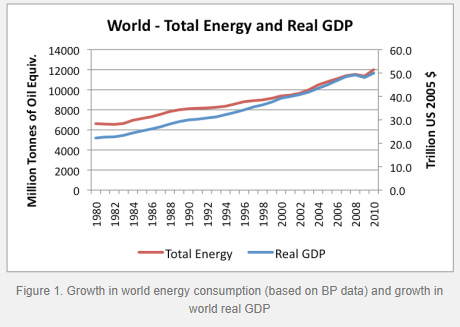
But infinite growth is what capitalism and the markets are advocating, because they want business as usual (BAU). There are researchers like Hannah Ritchie saying that there are signs that GDP, which is used as shorthand for growth, is decoupling from environmental pressures (chart above shows the correlation between GDP and fossil fuel use), but those signs are not conclusive. Of course, things might improve. The future’s not set in stone, and we have no way of knowing what will actually happen, and technological miracles might give us a new lease of life, but given that past civilizations collapsed on a more local scale - or a much larger scale if you think of the Roman Empire - what do we think the current course is taking us towards for a globally connected civilization?
While in the last article I mainly focused on climate change related risks as I understood them, there are obviously various other aspects to the polycrisis. Remember, climate change is a symptom of overshoot. From that same article is this image that is a startling reminder of how narrow a focus most solutions address, because the focus is mainly on carbon emissions.
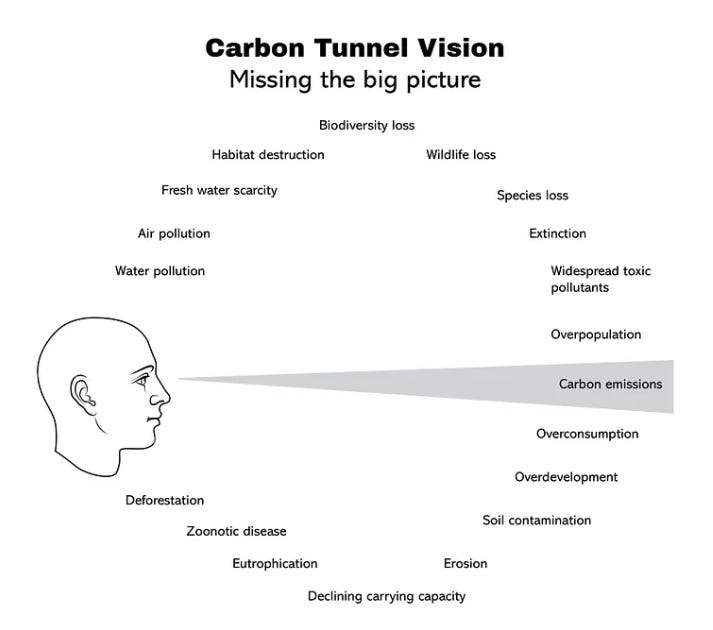
Once you start looking at the wider picture, the solutions proposed to simply cut down emissions by cutting down on fossil fuel use seem both insufficient and impractical. Because even if we cut down fossil fuel use on “discretionary” spending - leisure travel, crypto and AI (don’t “@me”, tech bros), making useless plastic crap that will get discarded after whatever celebration they were created for is over - there are plenty of other areas where we need to figure out how to replace fossil fuels with viable alternatives. Agriculture, cement manufacture, pharmaceuticals, essential transport - all are driven by fossil fuel use and all require replacements “at scale” as the industry likes to say. Until then we have to plod along with what we have and hope that something better comes along. At the same time requiring growth in all sectors!
In my last role, I was working in the ESG (Environmental, Social, Governance) space and hearing a lot of buzzwords: Net Zero, NDC, NGFS. ESG is highly aspirational, and highly controversial. But more than that, it seems like another way for capital to exert itself. Don’t get me wrong: there are highly motivated people, especially those who are young and whose very futures are at stake, working in this area. But ultimately, the viability of any system depends on money. With enough of that, even pie-in-the-sky projects get built; without it, even practical ideas get rejected.
Solutions?
If someone asks why nothing is being done to fix the issues, the answer might be that it’s India and China who are the major polluters now, not us, nosiree! No regard for the fact that developing economies might also want a standard of living to match the West, and that they might be able to do it in a greener fashion if there was more help from their past (and some would say present) colonial overlords. And certainly no regard for those societies that are already foundering and require urgent attention right now. Those who might actually have had any ability to change our disastrous course had their voices cast aside. They can sound all the alarms they want now, but the markets will continue to dictate the course and say “full-speed ahead” until the wheels come off.
To be clear, it’s not like companies are doing business in a vacuum, because in the end they are serving the interests of the public who want stuff. Stuff like food made cheaply from fossil fuels utilizing the Haber-Bosch process, even the replacement for which imposes significant energy demands; the same food being processed and packaged and transported, again using fossil fuels; fresh water, harder to get and becoming more scarce as competition increases with industries like agriculture; vehicles, which require materials to be mined and tires which in themselves are heavily polluting (so EV or not doesn’t matter in that regard); affordable housing requiring concrete and lumber. The list goes on. They require willing participation from us regular folks. You could say that marketing has done a number on us and made us into the consumer culture that we are now. But as it stands, the fact is that we demand things to be cheap for everyday living and also for leisure activities.
You often hear people say that individual choices can hardly make a difference in our progress, that governments need to step up and make laws to force producers to change how things are made. Implicit in this argument is that we want to go on with our lives as usual, but the methods of manufacture and delivery need to change. Well, regulatory capture exists, as does lobbying. Governments are feckless and with the wave of right-wingers coming into power after elections around the world this year, we might as well say goodbye to any marginal gains made in the last decade (not that there are very many) because most want to gut regulations further. And are anti-immigrant, so the wave of climate refugees are going to have a harder time finding a place to live. So there will be (more) wars, and more refugees. A vicious cycle.
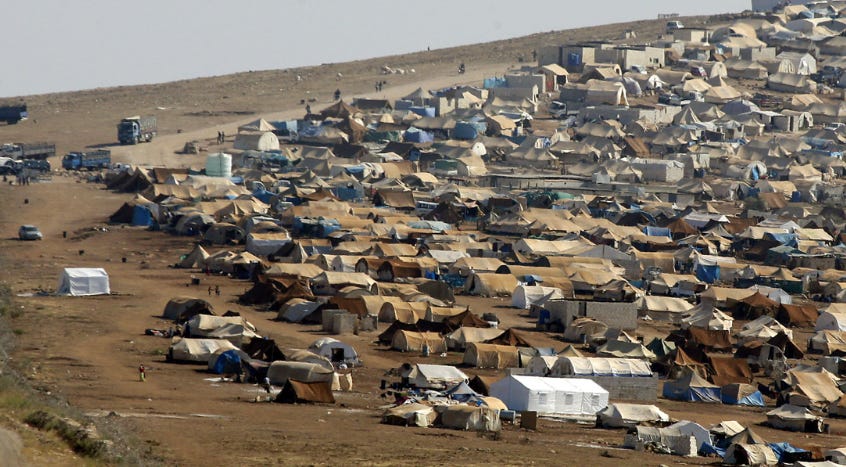
The original goal of the Paris agreement was to “to hold global temperature increase to well below 2°C above pre-industrial levels and pursue efforts to limit it to 1.5°C above pre-industrial levels”. In July 2024, the planet had been over 1.5° C warmer than the pre-industrial average for about a year. The COP summits are being headed by oil producers. Fossil fuel use continues to rise. We’re failing those goals. Some think we were never going to meet those goals, so we should go all in for building a super-intelligence that might be able to help us fix it.
Technical solutions just seem to be techno-optimism to me. And financial solutions seem equally useless. Carbon credits seem to be a sham, just a way for companies to balance more ever-teetering numbers. Carbon capture (nicely rhymes with regulatory capture, eh?) is a beautiful dream; what is removing 3000 tonnes of CO2 per year in relation to the about 35 billion tonnes we emit per year? How many of these plants do we need to be building every year, nay, every month, to make a difference? How much energy will they need to run to capture the emissions that will be emitted by running them?
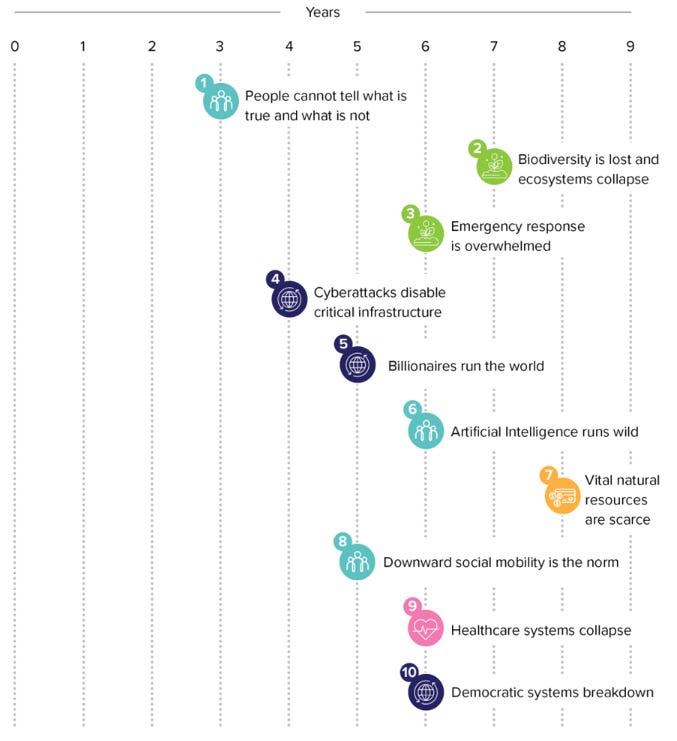
Even as I write this, I’m falling into the same way of thinking as the “Carbon Tunnel Vision” image above, where I’m focusing almost exclusively on fossil fuels and climate change. But there are a multitude of factors to worry about. The Canadian government even commissioned a study from a think tank about plausible disruptions to society; no surprise that ecosystems collapse within the next decade is top among the concerns but look at all the other dangers. We’re drowning in propaganda and bullshit and we can no longer tell the truth. And we need to know the truth to fight the various crises.
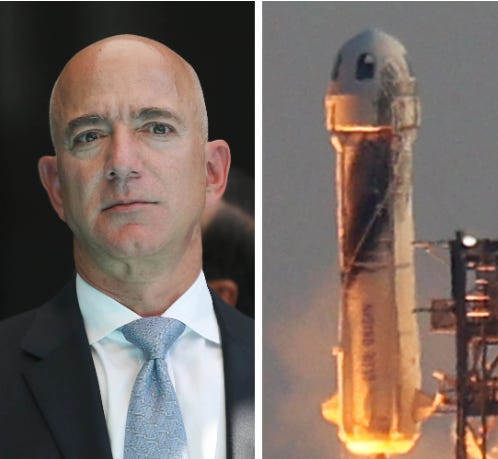
We’re failing ourselves and all other life on this planet. It’s a hard fact to accept. We will go on, stumbling and bumbling our way towards a future that, by all accounts, will likely be miserable for most people on this planet. Except maybe for the exceedingly rich who, when they are not selling us dreams of a utopia powered by AI or whatever is the latest toy that they’ve come up with that sucks up resources like there are no limits on a finite planet, are busy concocting their escape plans. Like building bunkers on private islands or traveling to Mars on their phallus-shaped rockets. Nothing like a good hedge to be prepared for any eventuality, I guess.
So, what to do? Pray that something better will come along and save us? What does “save” even mean? Continue our way of life unchecked at the expense of the natural world and hope that the later generations figure it out? Keep plodding on till the wheels fall off and that we get some kind of a civilizational reset and the horrors that will come with it? The last may be unavoidable anyway, since changing the behavior of even just the 100 companies seemingly responsible for a majority of greenhouse gases would be an arduous task.
If your head is swimming by now, welcome to the club. If this piece has so far seemed like a high school newspaper article summarizing everything that’s going on, it was not meant to be. It contains things I was actually reading and learning in some form or the other over the last decade or so. If I’m using a passive tone for describing something, it’s because I want to distance myself from it just a bit and present it in a somewhat neutral - even if slightly biased - way.
I’ll end this long-winded and thoroughly depressing piece here. I was experiencing major cognitive dissonance for over a decade, working in the fintech industry that drives so much of what we view as progress, but what I have come to view as having an overwhelming number of negatives. So in the next article I’ll write about what I decided to do to reduce that cognitive dissonance loudly playing the drums in my head (maybe just a teeny-tiny bit). In the meantime, I’d like to give this song recommendation. I listen to it very often, maybe too much so, but it gets the point across so much better than I ever could.
Link to part 4: